Now I know why they call this region a tropical rainforest. It rains just about everyday. Most of the time just for a short while. Then the sun comes out and it is hot and humid. When in Oman I could handle the 100’s because it was dry. Here in Indonesia the humidity is tougher to put up with. I sweat so much water is dripping down my arms. I discovered I don’t need an iron for my wrinkled clothes. I just set them out on my balcony and in a 1/2 hr they are wrinkle free. Presto!
As stated in the past entry, Stewart’s purpose here is to travel with a few other appointed people to collect information about the villages and coral reefs (and I was allowed to come along). It was an extraordinary experience to meet these people and see how they live their lives. For me this trip seems to be about connecting with people.
We traveled with two ladies on this trip: Dr. Alison Green from Australia whose specializes in coral reefs and coral reef fish, and Hilda Lionata who spent time with Stewart, concentrating on social economics, and cultural and governance considerations. Hilda speaks Indonesian and English, so she has been helpful interpreting for us… among many other things.


You can see that Alison has spent much time in the water by looking at this photo. She say’s it’s time for a new suit due to the fact she is getting sunburned where the holes are.
We flew from Ternate to Morotai, the island where Paul—the intern we have been with since arrival—has been working. Paul had made all the arrangements for this 2-night/2-day trip. We stayed on the far side of the island in bungalows and I finally got to see some white beaches and that beautiful turquoise water. We all got to know each other and met with the men who would supply the boat, and a dive master who would map out where we were going.
Early the next morning, a large speed boat carried us smoothly over calm waters. We passed a huge pearl farm. Allison told me that pearl farming is a good thing, ecologically. It protects the area’s ocean bottom since fishermen and other boats are prohibited.


Our first stop was the island of Roa at Posi Posi village where we were greeted by the leader of fisherman’s coop. The village has 250 people; 40 of them are fisherman. There is nutmeg and clove production here also. We met in a little building close to the pier for a discussion on fishing activity and shark fishing. I saw men fishing from the pier using round nets tossed into the water with amazing precision, then pulling the nets up onto the dock and picking out the fish. This is the accepted technique of fishing in this area. There are only a few motor bikes on island.


We then walked down the main road and saw homes made of concrete or wood. A few young women walked past us with their little babies in their arms. They had such big smiles on their faces and seemed to be so proud of and in love with their newborns. As we walked farther along I noticed many people sitting outside next to a small building. The Doctor was at the village that day, and people were waiting for their turn. They all waved, saying hello with big smiles.


Looking down a side street I noticed what looked like gardens, so we went and checked them out. Many people have very healthy-looking gardens, as well as pigs, chickens, and a few cows.


In the midst of this walking, I’d stop often to shake hands and take photos. At some point I realized how hot I was, and that my toes were turning very red and feeling sore. Luckily, I had my zinc lotion with me and loaded it on my toes more than once. On the porch of one home, a very old sewing machine was set up with fabrics, and many people of all ages were sitting in the shade. I walked over and asked if I could take a photo of sewing machine and the woman said, “Yes”. She was selling frozen mashed mung beans, and since we were all very hot we bought some. It was like eating a popsicle; good and refreshing. We sat there for some time, all chatting with the help of our interpreter.


The little boy is demonstrating how to eat the frozen mung beans
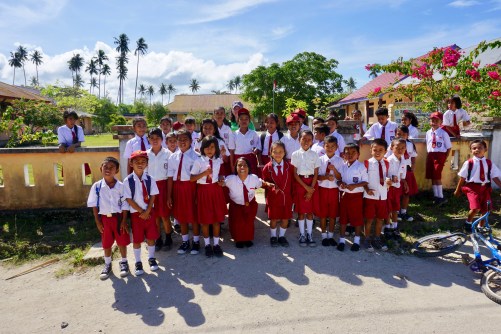
There were 3 schools for the different levels of education and all the students wore uniforms and were excited to see us. I asked them all to gather for a photo and they did; not at all shy.
Along the road next to the stone walls were many crosses. I asked about this and was told that the island is mostly Catholic and the crosses are for Easter. There are actually two churches and two priests who live on the island.
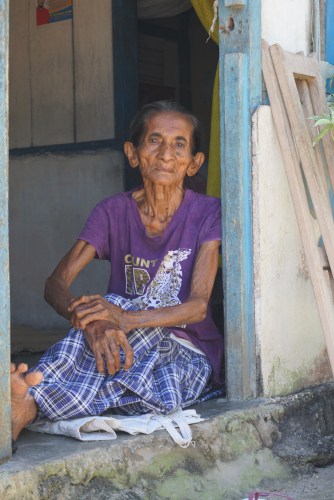
I noticed an older lady sitting in her doorway who looked at me in amazement. I smiled big and waved to her, and she returned the gesture. I felt sorry for her, so I went up to her, shook her fragile hand, and asked if I could take a photo of her. She said, “Yes,” then pointed to her crutches and her leg… which was not there. Very touching for me. I did find out she is 82 years old. God bless her.
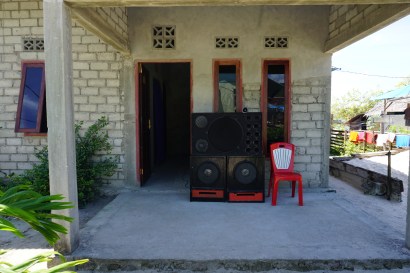
At one point on our walk I heard this very loud music… like Jimmy Buffet. As we got closer to the house it was coming from, I saw a gigantic speaker on the porch. Never saw a soul, but they were certainly enjoying their life on the island next to a white beach and beautiful blue water.
There is electric power on Posi Posi, but only on from dusk to midnight. Water comes from inland, distributed through pipes.
We said our good-byes and headed to another island.
This next island, Dodola is small, and the government is building a small resort there; some of the infrastructure is already in place. There was a nice dock and beautiful white beaches so some of our group rested under a tree and talked about the socio-economics of it all.


I walked along a path towards a small brush fire with a family tending it; a little boy was running around with no clothes with his father. The boy was playing with a small black bird with red eyes. They’d caught it and tied a thin string around its leg. When I came up to them, they immediately offered the bird to me as a gift. Yikes! I couldn’t take poor thing. I just wanted to untie it and let it fly away. Hopefully they let it go. I did take a photo of the family… after they put a shirt on the naked boy. It turns out they are the only ones who live on this island, and people from nearby islands visit for the day.


The little boy in black T shirt is the one who was playing with bird.
We took the boat out to Kolorai Island where we tied up at an amazingly colorful dock. Paul had lived there last year and knew the villagers, so he had arranged lunch at someone’s home. What a colorful place this is. We were all served fish, rice, and these chips made from shrimp that were delicious. The woman who fixed our meal was so very kind and seemed honored to have us there. She had three daughters, one of whom was holding a baby… not sure whose baby it was. She let me walk through her home—the pictures tell the story—and held me in her arms when we were in the kitchen. We held hands and did the cheek to cheek goodbye when we left.


There was one home stay which is like an airbnb, in the village which we got a tour of, and a small store, and a few items they make locally; packaged ground fish and a sort of peanut snack. I bought the peanut snack and said “no thank you” on the ground fish. One older person made bracelets and hats from palm leaves. I had to buy something; it just didn’t seem right not to since the cost is just pennies and they need the support… so I bought 2 bracelets.


We said our goodbyes once again, loaded back on the boat and then went snorkeling and diving. “WOW!” is all I can say. Allison, who has been all over the world working on coral reefs, said this reef is one of the most diverse in the world. Their goal is to map this as one of the protected areas. I saw sooo much color and texture in the reefs and the fish.
Back on the boat, and back for another night in our bungalow on Morotai: Allison, Hilda, Stewart and I met at this sweet little hut next to the beach where the servers brought cold beer. Yep… cold, tall beer that went down nicely while watching the sun setting behind all these islands in the distance.


Before we flew back to Ternate the next day, we visited a few historical sites. One was an area on a point of land where important ancestors were buried. We didn’t walk too far into the wooded area so as not to seem disrespectful.


These sites are marked by large rocks that are then covered with white cloths. It was suggested to Paul to get more information and assure that areas like this are well marked and that the community protects them from development.
Which reminds me that at the hotel in Ternate, at breakfast on our second day, I met a gentleman who is a developer and is planning to build 5 golf courses and a hotel on Morotai. Stewart, Paul and I spent some time talking with him. We asked questions about the development and I then asked, “What are you going to do about all the trees you are going to cut down? Are you going to replace trees within the development?” His answer was, “I’m going to build wide roads to these golf courses and hotel.” Yikes. No, that is not what I wanted to hear. He then told us that his idol is Donald Trump, that he had read all Trump’s books, and he wants to be like him.
We also went to a World War II museum way out in the middle of the forest. This man has been collecting relics that he finds from the war. He has photos, guns, spent cartridges, helmets, bowls, coins, flags, etc. What was really touching is that he had dog tags. We felt like the families might want them, if the families could be found.
I almost never think of my father (just because I don’t know him) but I did here. He served in World War II and was stationed in the Philippines which is much like here in Indonesia. He was wearing and using the same things I was looking at in this museum.


When we arrived back in Ternate, Alison wanted to find the area where Alfred Russel Wallace, the British naturalist, lived when he wrote his famous letter to Darwin explaining Wallace’s theories on evolution (which the people here call, “The Letter From Ternate”). Some conspiracy theorists say that Darwin actually reworked his own theory based on Wallace’s, siting a 2-week delay between when Wallace’s letter should have been received and the time Darwin sent it on for peer review. But the bottom line is that their similar theories were presented to the Linnaean Society in 1858, a co-authored paper on evolution and natural selection which shook both the scientific and religious worlds of the time.

I find it very interesting to think that in Ternate, in the Wallacea Region comprised of thousands of islands between Eastern Indonesia and Australia, in this very tropical rain forest, the theory of evolution began. And that the people here are addressing the same problems which concerned Wallace when he returned to England in 1863 and wrote,
“Future ages will certainly look back on us as a people so immersed in the pursuit of wealth as to be blind to higher considerations.”

 Sauntering new roads with Ruby Begin reading from the bottom Oct 2016
Sooo interesting…enjoyed every word!! hat an experience!!
LikeLike